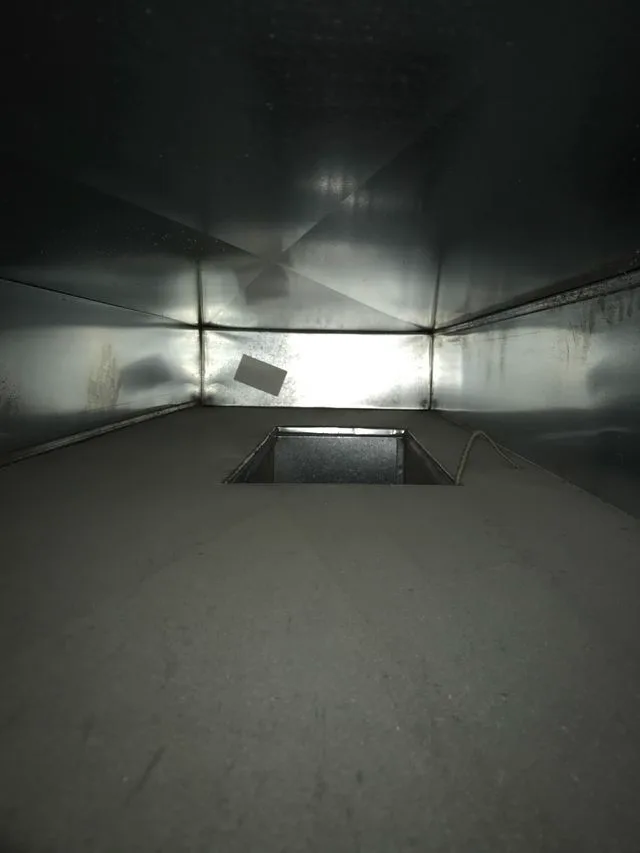
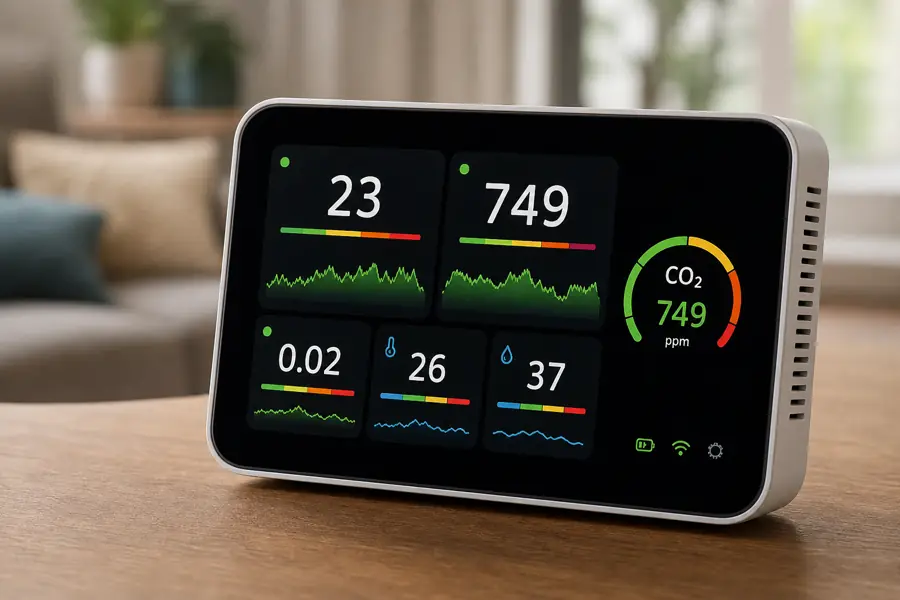
It's the first cold night of the season. You nudge the thermostat up, the furnace kicks on for the first time since spring, and within a minute the whole house smells like something is burning. Every fall, this exact moment sends thousands of people to their phones asking the same question — so here's the straight answer, and the part most articles skip: what is burning, and why it's a preview of what's inside your system.
What's actually burning
Nothing is on fire. What you're smelling is dust — a summer's worth of it — sitting on the hottest surfaces inside the furnace. When the burners light and the heat exchanger climbs to operating temperature, that thin layer of dust scorches, and the blower pushes the smell through every supply register in the house at once. That's why it seems to come from everywhere rather than from the furnace closet.
Three places collect the dust that burns off:
- The heat exchanger and burner assembly. These get hottest fastest, so they're responsible for the sharp smell in the first few minutes.
- The blower wheel and motor. The blower runs for both heating and cooling, so it collects dust all year. It sits right next to the heat exchanger, and a coated blower keeps shedding dust onto hot surfaces cycle after cycle.
- The supply ducts closest to the furnace. Warm air passing through dusty duct runs picks up a lighter, "hot attic" version of the same smell.
The amount of dust decides how long the smell lasts. A furnace with a fresh filter and a reasonably clean blower burns off its dust in one cycle. A furnace with a blower wheel that looks like the photo above keeps producing the smell for days, because every time the fan spins up it shakes loose more dust onto the heat exchanger.
How long is normal — and when it stops being normal
The rule of thumb: strongest in the first 5–10 minutes, gone within an hour, and it shouldn't return on the next cycle. Cracking a couple of windows speeds it along. Here's how to read what you're getting:
| What you notice | What it means | What to do |
|---|---|---|
| Dusty burning smell, fades within an hour | Normal seasonal burn-off | Open a window; replace the filter if it's due |
| Same smell, but lasts several hours or a full day | Heavier dust load — usually a dirty filter or blower | Replace the filter, run fan-only for 30 minutes (see below) |
| Smell returns every time the furnace cycles on, for days | Dust coating the blower wheel or the supply ducts | Needs mechanical cleaning — a filter won't fix it |
| Smell came back after a new filter and a fan-only run | Source is downstream of the filter (blower, coil, ducts) | Have the blower and ducts inspected |
The 4 furnace smells that are not dust
Dust has a specific character — dry, a little like a hot iron on a cotton shirt. These four are different, and each one has a clear action. Don't wait an hour to see if they fade.
1. Rotten eggs or sulfur
Natural gas is odorless; utilities add that rotten-egg smell so you'll notice a leak. If you smell it, don't flip switches or light anything. Leave the house and call your gas utility's emergency line — or 911 — from outside. This is the one smell where you do not investigate first.
2. Burning plastic, rubber, or "electrical"
An acrid, chemical burning smell usually means an overheating motor, a failing capacitor, wiring insulation, or a foreign object (a plastic bag pulled against the return, a toy dropped into a floor register) sitting against something hot. Turn the furnace off at the switch and call an HVAC technician. If you see smoke, leave and call 911.
3. Sharp chemical or formaldehyde-like smell
A cracked heat exchanger can let combustion gases into the air stream, and some people describe it as a sharp, chemical, or formaldehyde-like odor. It's also the failure that produces carbon monoxide, which has no smell at all. If you notice this, turn the furnace off and have it inspected before running it again — and if your CO detector sounds at any point, get everyone out first. The EPA's guidance on carbon monoxide in the home is worth two minutes of your time before heating season, and a working CO detector on every level of the house is non-negotiable.
4. Musty, "dirty sock," or moldy
This one is more common in fall than people expect. Summer humidity leaves the evaporator coil and the ducts near it damp, and microbial growth on those surfaces gives off a musty smell when warm air starts moving across them. It's not an emergency, but it's not something that burns off either — it means moisture got into the system and the surface needs to be cleaned and dried out. If you had a damp summer, this is the smell to watch for; our guide on how to check your home's air quality walks through what to test if it lingers.
How to make the burning dust smell go away faster
If it's the dusty smell — not one of the four above — here's what actually helps, in order of effort:
- Replace the furnace filter. A filter that has been catching dust all summer is the first thing warm air hits. ENERGY STAR's advice is to check it monthly and swap it at least every three months; start heating season with a fresh one no matter what.
- Vacuum the registers. Pull off the supply and return covers you can reach and vacuum the first foot of duct. That's where the visible dust is, and it's where the smell in each room starts.
- Run fan-only before you run heat. Set the thermostat's fan to "On" (not "Auto") for 15–30 minutes before the first heat cycle. This moves the loose dust through the filter without cooking it.
- Open windows for the first cycle. It won't reduce the dust, but it clears the smell instead of letting it settle into fabrics.
If you've done all four and the smell is still coming back each cycle a day or two later, the dust isn't loose anymore — it's bonded to the blower wheel and the walls of the supply trunk, and no amount of filter changes will reach it. That's the point where cleaning the system is the fix, not a routine. The EPA's standard on when duct cleaning is warranted is heavy debris that restricts airflow or comes out of the registers — a blower that keeps shedding into the air stream every cycle qualifies.
What we find inside blowers every October
AirFresh Inc. has been cleaning HVAC systems across Chicagoland since 2005, and the first two weeks of heating season are the same every year: the "it smelled like burning for three days" calls start the morning after the first cold night. When we open the blower compartment on those jobs, it usually looks like this.
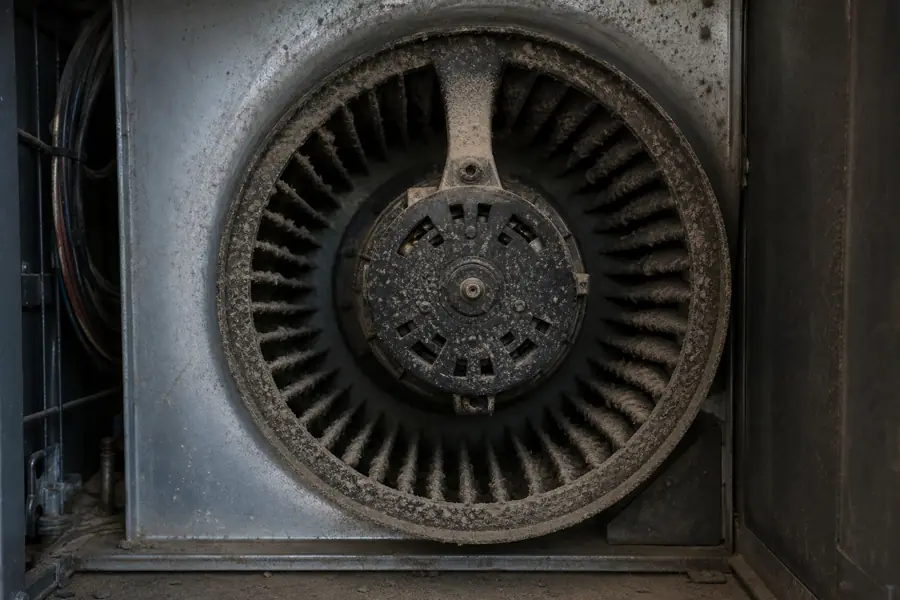
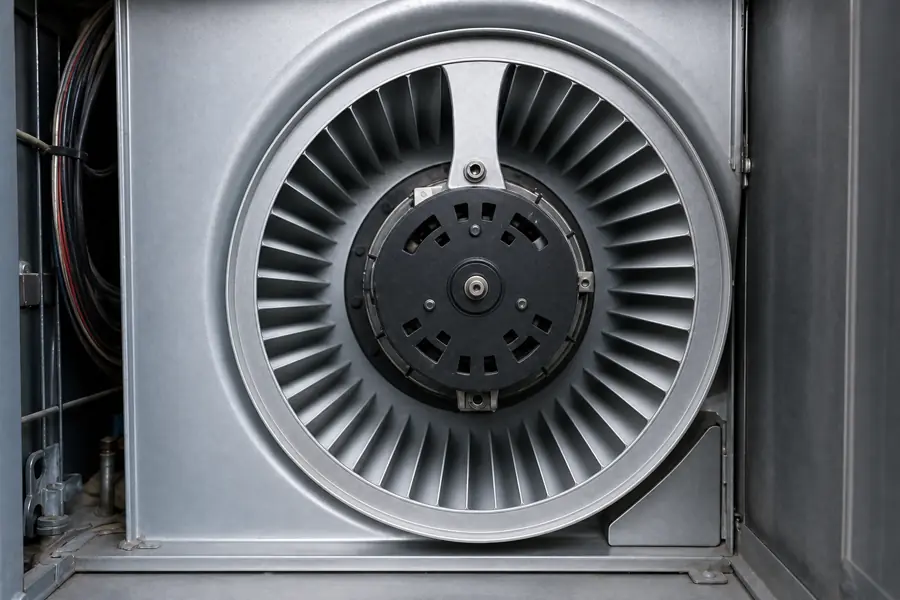
A furnace blower wheel from one of our whole-system cleanings — drag the handle to compare. Every blade was carrying a felt-like layer of dust; the motor housing in the center was coated too.
Look at the before image for a second. Every one of those curved blades is supposed to be a thin, sharp-edged piece of sheet metal. Instead they're rounded off with a layer of compacted dust, the motor in the middle is coated, and the housing around it has the same gray film. Two things follow from that:
- That's the burn-off supply. A wheel like this spins at roughly a thousand RPM a foot away from the heat exchanger. Every startup shakes loose a little more dust onto hot metal, which is exactly why the smell "won't go away" in some homes and vanishes in an hour in others.
- It's also why the house feels stuffy. Dust on the blades changes their shape, so the wheel moves less air per revolution. Homeowners describe it as "the furnace runs forever but the back bedroom never warms up." The same buildup that makes the smell is quietly cutting airflow.
This is why we don't sell duct cleaning that skips the furnace. Cleaning the ducts and leaving a wheel like this in place just recontaminates the system on the first cycle. Every whole-system package we do covers the return and supply vents, all main trunk lines, and the blower cleanout — you can see the full breakdown on our air duct cleaning page. We put the system under negative pressure so what comes off the wheel and the duct walls goes into our collection unit rather than back into your rooms, then walk you through what came out.
What it costs is published, because the burning-smell call is exactly the kind of moment where people get sold a package they don't need. Every job starts with a $175 inspection — we open the blower compartment, look at the coil and the trunk lines, and tell you honestly whether this is a "swap the filter and you're fine" situation or a real buildup. The $175 is credited toward the work if you go ahead. From there, whole-system cleaning is priced by the number of furnace systems in the home:
Plenty of homes only need the supply side cleaned, so the final number often lands below the headline price, and it's locked in after the inspection — the quote you get is the price you pay (here's what air duct cleaning costs in Chicago, broken down across three typical jobs). If you'd rather beat the first-cold-night rush entirely, the case for doing this before the furnace runs at all is the same one we make every August.
Your first-cold-night checklist
Five minutes before you turn the heat on for the first time this fall:
- Test the CO detectors. Press the button on every one. Replace batteries, and replace any unit older than its stated lifespan (typically 7–10 years).
- Swap the furnace filter. Write the date on the frame so you know when it went in.
- Clear the space around the furnace. Boxes, paint cans, laundry — anything stored against it over the summer moves out.
- Check that every register is open and unblocked. A rug or a couch over a supply register makes the smell worse in that room and starves airflow everywhere.
- Run fan-only for 15–30 minutes, then heat. And crack a window for the first cycle.
- Note how long the smell lasts. Under an hour, you're done. Still there tomorrow, the dust is in the blower or the ducts.
Frequently asked questions
Is it normal for a furnace to smell like burning dust when you first turn it on?
Yes. On the first heating cycle of the season, dust that settled on the heat exchanger, burners, and blower over the summer burns off. It's usually strongest in the first few minutes and fades within 30 to 60 minutes, and it shouldn't come back on later cycles.
How long should the burning dust smell last?
Typically 30 to 60 minutes on the first run. If it lasts more than a few hours, returns every time the furnace cycles on, or comes back after you've replaced the filter, there's more dust in the blower or ductwork than a single burn-off can clear.
Which furnace smells are not normal?
Four: rotten egg or sulfur (possible gas leak — leave and call your gas utility from outside), burning plastic or electrical (turn the furnace off at the switch and call an HVAC technician), a sharp chemical or formaldehyde-like smell (possible cracked heat exchanger — turn it off and have it inspected), and a persistent musty or dirty-sock smell (mold or bacteria on the coil or in the ducts).
How do I stop my furnace from smelling like burning dust?
Replace the filter, vacuum the registers you can reach, and run the fan-only setting for 15 to 30 minutes before the first heating cycle. If the smell persists after that, the dust is on the blower wheel or inside the ducts and needs to be removed mechanically.
Does duct cleaning get rid of the burning dust smell?
It removes the source. A proper whole-system cleaning includes the furnace blower cleanout, which is where most of the dust that burns off actually sits. We start with a $175 inspection credited toward the work; whole-system cleaning is $550 for one furnace, $950 for two, and $1,250 for three, and always includes the blower. Full details are on our inspection page.