By mid-October in Chicago the windows are closed for the year, the furnace is running every day, and the holiday calendar is filling up. The basement family room is about to get a lot more use: kids home from school, a sofa bed for visiting relatives, the TV everyone watches on Thanksgiving. It's also the season when the gas you can't see, smell, or taste builds up the most. If your home has never been tested, or it's been more than two years, this winter is the time to do it.
Radon in 60 seconds, and why Illinois should pay attention
Radon is a radioactive gas produced naturally as uranium breaks down in soil and rock. It seeps up into houses through foundation cracks, sump pits, floor drains, and gaps around pipes, and collects inside. The EPA estimates radon causes about 21,000 lung cancer deaths in the U.S. every year. It's the leading cause of lung cancer among people who have never smoked and the second leading cause overall. For smokers the risk multiplies: at the 4.0 pCi/L action level, the EPA puts the lifetime risk at roughly 62 lung cancer cases per 1,000 smokers, compared with about 7 per 1,000 people who never smoked.
Illinois is not a place to assume you're fine. The Illinois Department of Public Health reports that in an IEMA study, 41 percent of Illinois homes tested came in above the action level. The Illinois Emergency Management Agency has found elevated radon in every county in the state. Neighborhood averages don't tell you much, either. Two houses on the same block can test very differently depending on the soil under them, the foundation, and how tightly each one is sealed. As IEMA's own radon map puts it, every home should be tested.
Why radon climbs once the furnace comes on
Radon doesn't come from your furnace. Running the furnace and closing the house for winter just changes how air moves through the building, and in ways that favor radon. Four things happen at once:
- The stack effect. Warm air rises. On a 20°F January night with the house at 70°F, heated air leaks out through the attic, upper windows, and recessed lights. The air that replaces it gets pulled in low, and some of it comes from the soil under your slab and basement walls. The colder it is outside, the stronger that pull.
- A sealed house. In April or September, an open window or two dilutes indoor air all day. From November to March almost nothing does, so radon that gets in tends to stay in.
- Exhaust fans and appliances. Every fan that pushes air out of the house (the dryer, bathroom fans, a range hood running through a long holiday cook, a fireplace drawing up the chimney) lowers indoor pressure a little more. Replacement air has to come from somewhere, and the foundation is one of the places it comes from.
- Frozen, snow-covered ground. When the top layer of soil freezes or is under snow, the gas below it has fewer ways to escape into the open air. The basement becomes an easier way out.
EPA guidance notes that radon varies from day to day and season to season, and in homes like ours the heating season is usually the high end of that range. That's why a summer result of 3.1 pCi/L doesn't mean much in January.
Why a winter result is the one you want
A short-term test is a snapshot. Taken in winter, it captures your home under close to its worst conditions, which is exactly what you want to know before deciding whether to act:
- A low winter number is reassuring. If you're under 2.0 pCi/L in January, you can be fairly confident your year-round average is low too.
- A high winter number is worth taking seriously. It shows what your family is breathing during the months you spend the most time indoors. In Chicago, that's close to half the year.
- Closed-house conditions are easy. Every valid short-term test needs the windows and outside doors shut. Keeping a house sealed for three days in July is miserable. In December it's just a normal week.

A holiday-season testing calendar
You don't need to plan your winter around a radon test, but a little timing helps:
| When | What to do | Why |
|---|---|---|
| Late Oct – mid Nov | Run a short-term test (48+ hours) | The furnace is running, the house is closed, and you'll have results before guests sleep in the basement at Thanksgiving. |
| November | Start a long-term test (90+ days) if you want the full picture | A test running from November to February averages out the whole heating season instead of one week. |
| December | Avoid starting a 2–3 day test during a blizzard or high-wind event | The EPA advises against short tests during unusually severe storms or high winds, which can skew a short reading. |
| January | National Radon Action Month: test if you haven't yet | The EPA's annual reminder lands in the middle of peak season. |
| Feb – March | Follow up on any result at or above 4.0 | Confirm the number, then plan mitigation before the windows open again. |
How to run a valid test (even with a house full of guests)
Whether you use a hardware-store kit or have a professional radon test done, placement and house conditions decide whether the number means anything. These come straight from the EPA's homeowner guidance:
- Close up 12 hours before. For a 2–3 day test, close windows and exterior doors at least 12 hours before the test starts and keep them closed until it ends. Normal coming and going is fine.
- Test the lowest level you actually use. That's the basement if anyone spends regular time there, otherwise the first floor. Use a lived-in room (family room, playroom, den, bedroom), not the kitchen, bathroom, or laundry room.
- Put the monitor about 20 inches up. Set it at least 20 inches off the floor, away from drafts, exterior walls, heat sources, and humidity. That means not on the hearth, not next to a space heater, and not beside the sump.
- Skip the window fans and whole-house fans. Short bursts from bathroom and kitchen exhaust fans are fine. Keep the fireplace damper closed when you're not using it.
- Tell the household. Holiday guests mean more people who might crack a window in a warm room or unplug a "clock" to charge a phone. A sticky note on the monitor saves a redo.
A professional test adds a calibrated continuous monitor, which logs hourly readings so you can see whether a spike lined up with an open door or a storm. You also get someone to explain the result. If the test is part of a home sale, IEMA's real-estate guidance says buyers and sellers are best served by a licensed measurement professional, and the Illinois Radon Awareness Act requires sellers to give buyers radon disclosure information before the contract is signed.
What your number means
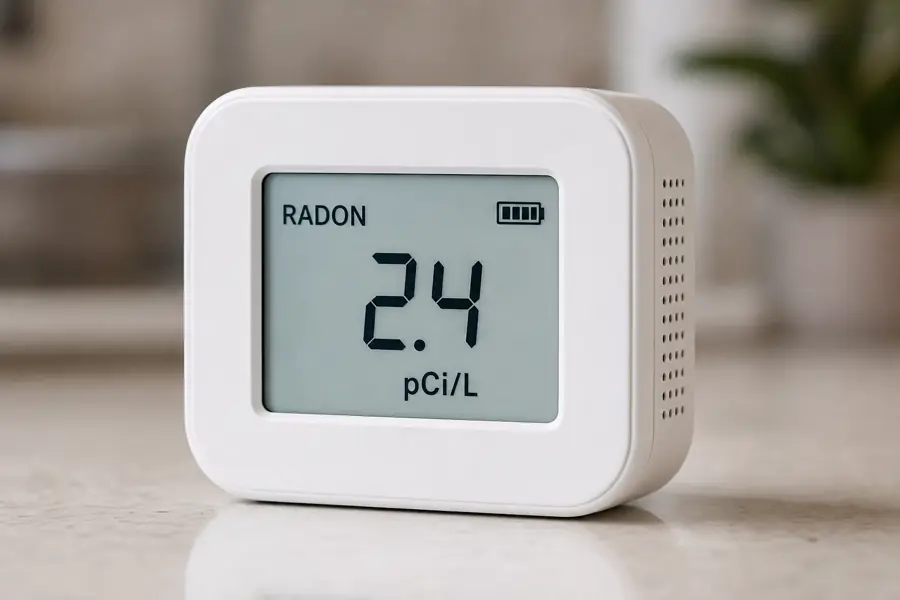
Radon is measured in picocuries per liter of air (pCi/L). Here's how the EPA's guidance breaks down:
| Result | What it means | Next step |
|---|---|---|
| Below 2.0 pCi/L | Low, but no level of radon is completely safe | Retest every two years and after any foundation work or basement finish |
| 2.0 – 3.9 pCi/L | Below the action level, but the EPA says to consider fixing it | Consider mitigation, especially if anyone sleeps or spends long hours on that level |
| 4.0 pCi/L or higher | At or above the EPA action level | Confirm with a second short-term or a long-term test, then fix the home |
A single short-term result close to 4.0 can go either way, which is why the EPA recommends a follow-up before deciding. The higher the first result, the more sense it makes to follow up with another short-term test rather than waiting 90 days for a long-term one.
"Our house is new, so we're fine," and other winter myths
"It's a new house." Since June 2013, Illinois's Radon Resistant Construction Act has required passive radon-resistant construction in new single-family homes. That's a good thing, but a passive pipe has no fan, and on its own it isn't guaranteed to keep levels below 4.0. Newer homes still need testing. The good news is that if one tests high, that passive pipe can often be turned into an active system just by adding a fan.
"We tested when we bought the house." If that was eight years ago, or before you finished the basement, it's out of date. Foundations settle and crack, and finishing a lower level changes both who's down there and how air moves. The EPA's rule of thumb is to retest every two years.
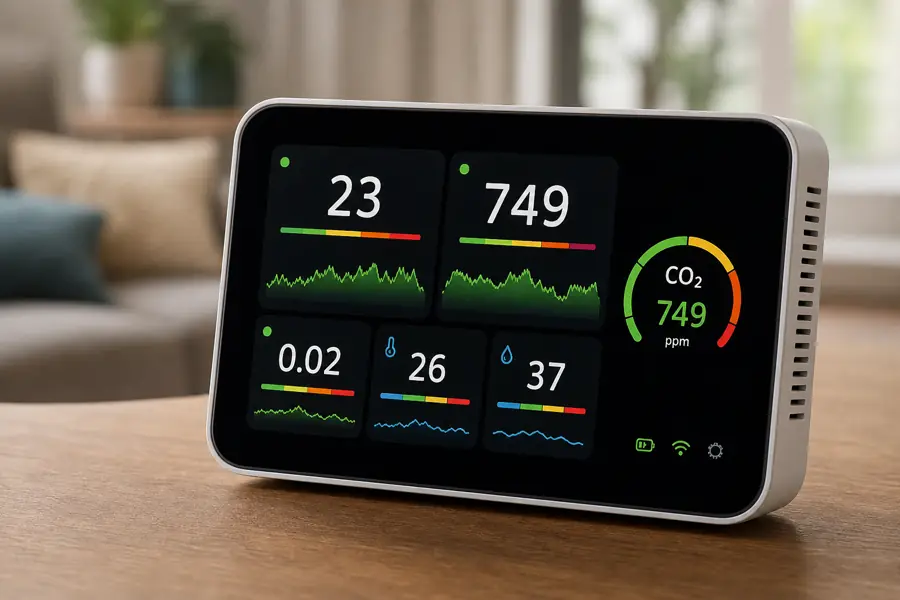
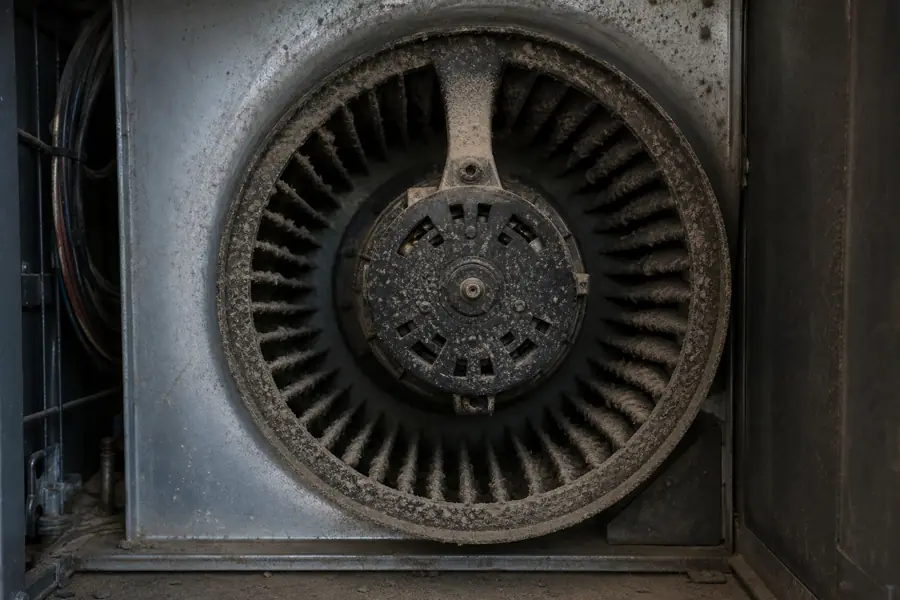
"We just had the ducts cleaned and we run an air purifier." Both help with dust, pollen, and dander, but neither one does anything for radon. Radon is a gas coming up from the soil, so it doesn't settle in ductwork and doesn't get caught in a standard filter. Most consumer air quality monitors don't measure it either. Indoor air quality testing and duct cleaning are worth doing for their own reasons, but radon needs its own test and its own fix.
If your winter test comes back high
A high result is common in Illinois and very fixable, and winter is a fine time to fix it. The standard approach is active soil depressurization: a sealed suction point beneath the slab, major entry points like the sump pit and foundation cracks sealed, and a quiet inline fan that pulls the gas from under the house and vents it above the roofline. Most installs take a single day, and the fan uses about as much electricity as a light bulb.
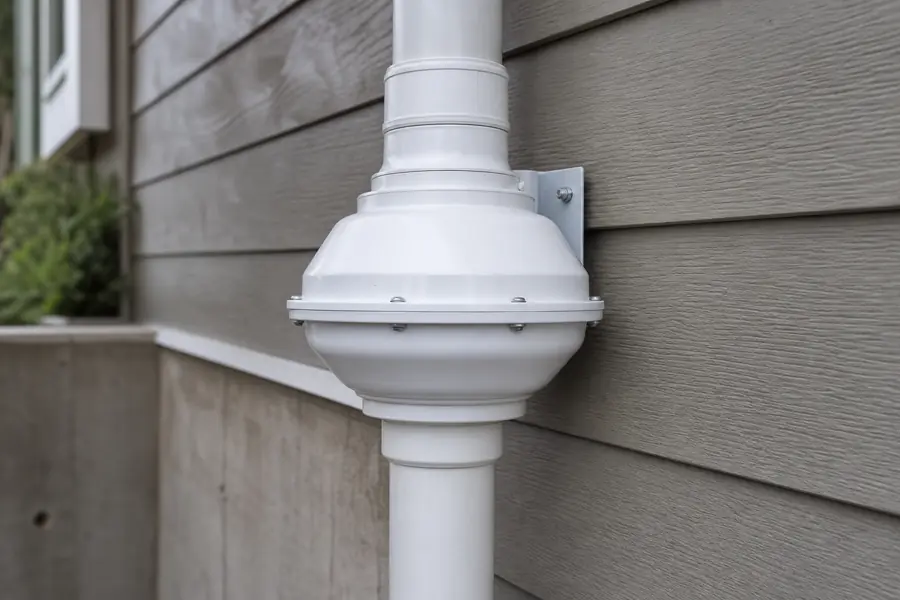
The EPA notes that most homes can be brought down to 2.0 pCi/L or below. Every radon mitigation system we install is guaranteed to bring your level under 4.0 pCi/L, and we confirm it with a follow-up test after installation. Fixing it in January means your basement is in good shape before spring, and before a listing photo if you're planning to sell.
Your winter radon checklist
- Haven't tested in two years, or ever? Schedule a test for late October through early March.
- Finished the basement, had foundation work, or added a bedroom downstairs? Test again.
- Hosting guests in the basement over the holidays? Test before Thanksgiving if you can.
- Close windows and doors 12 hours before a short-term test, and keep the monitor undisturbed.
- 4.0 pCi/L or higher? Confirm it, then fix it. 2.0 to 4.0? Think seriously about fixing it.
- Already have a mitigation system? Check that the manometer on the pipe still shows suction, and retest every two years.
Frequently asked questions
Is winter really the best time to test for radon?
For most Chicago-area homes, yes. Indoor radon tends to run highest during the heating season, because the house is closed up and warm air rising through it pulls soil gas in through the foundation. A winter test shows you something close to your worst-case level, and the closed-house conditions every short-term test needs happen naturally when it's 20°F outside.
Can I test for radon while I have holiday guests?
Yes. Normal coming and going through exterior doors is fine. What matters is that windows stay closed, outside doors aren't propped open, window or whole-house fans aren't running, and nobody moves or unplugs the monitor. If guests will be sleeping in a finished basement, test that level before they arrive.
What radon level is safe?
There's no known safe level of radon. The EPA recommends fixing a home at 4.0 pCi/L or higher and considering it between 2.0 and 4.0 pCi/L. Most homes can be brought down to 2.0 pCi/L or below with a mitigation system.
If my house was built after 2013, do I still need to test for radon?
Yes. Illinois has required passive radon-resistant construction in new single-family homes since June 2013, but a passive system has no fan and isn't guaranteed to keep levels under 4.0 pCi/L. Testing is the only way to know. If a newer home tests high, the passive pipe can often be turned into an active system by adding a fan.
Will air duct cleaning or an air purifier lower radon?
No. Radon is a gas that comes up from the soil, so duct cleaning and ordinary air purifiers don't remove it, and most consumer air quality monitors don't measure it. The proven fix is a mitigation system that draws the gas from beneath the foundation and vents it above the roofline.
How long does a winter radon test take?
A short-term test runs at least 48 hours, with windows and exterior doors closed for at least 12 hours before it starts. For an average over the whole heating season, a long-term test of more than 90 days can be started in November and read in February.